Subsurface processes
How do compaction, drought and flooding change the way water and contaminants move through soil?
Read moreSubsurface Engineering & Analysis Laboratory
We study how wildfire, flooding, drought, and urban development change the way soil filters pollutants. We use those findings to treat stormwater, restore contaminated soils, and protect groundwater.
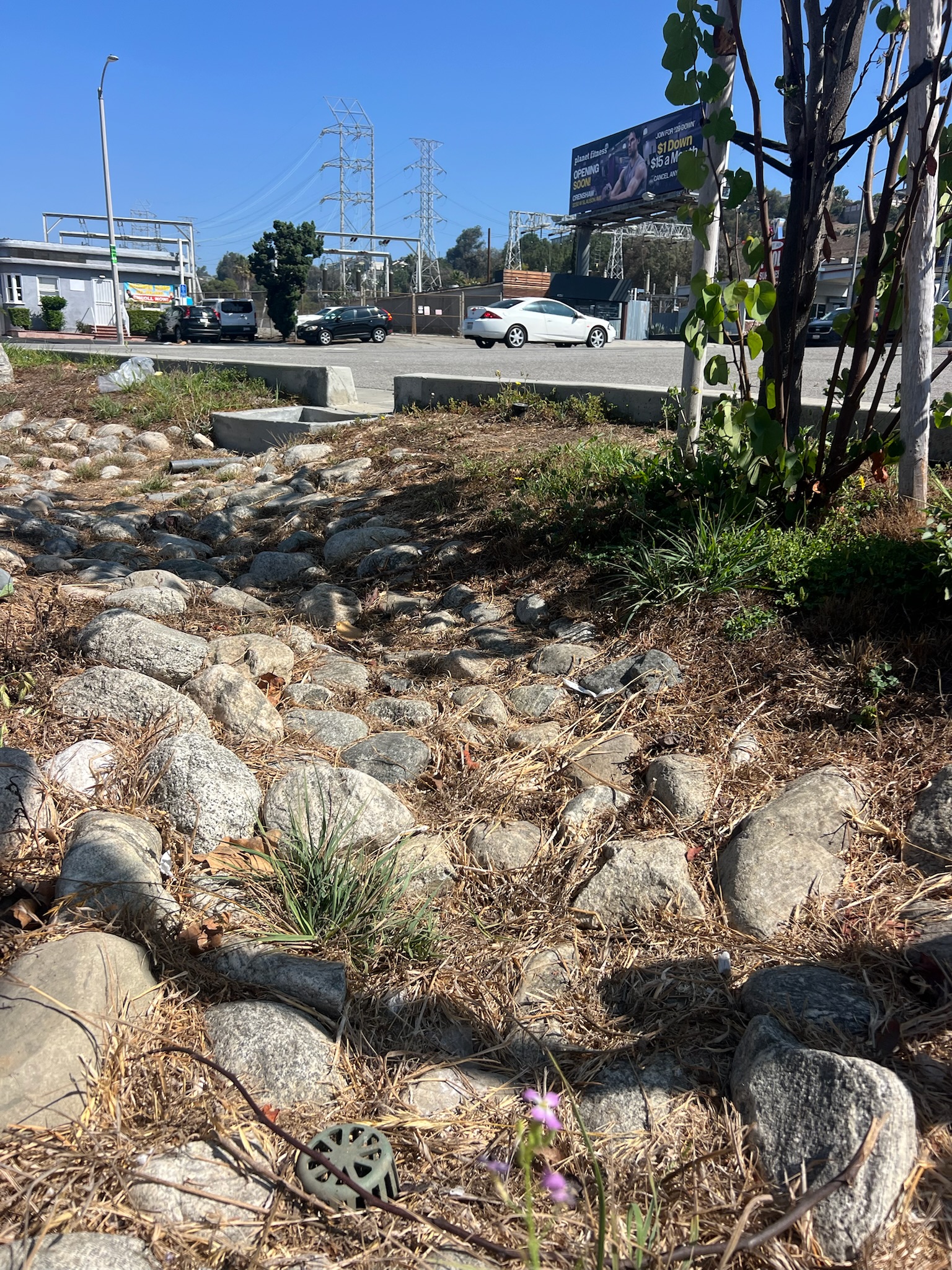
Research
Soil can filter pollutants as water moves through it. We study how urban development and extreme events change that ability, then use those findings to design better treatment systems.
How do compaction, drought and flooding change the way water and contaminants move through soil?
Read moreWe develop ways to treat polluted runoff and restore contaminated soils, including biochar-amended filters.
Read moreWe trace how microplastics and other small particles move through soil and water.
Read moreWe examine how environmental stress changes soil microbial activity and what that means for water quality.
Read moreFollow the Rain
Explore how a planted bioswale slows runoff, how water moves through soil, and what that means for groundwater.
Rain flowing over pavement can pick up sediment, microplastics, and other pollutants. SEALab studies how small particles move in water and soil.
Explore particle transport ↗A bioswale is a planted channel that slows runoff and gives it time to soak in. SEALab studies how materials such as biochar can improve stormwater treatment.
Explore remediation design ↗Soil structure affects how quickly water moves. Soil microbes also transform some pollutants as water passes through. SEALab studies how changing conditions affect those processes.
Explore the soil microbiome ↗Some infiltrating water can travel deeper over time. What reaches groundwater depends on the soil, flow paths, and which pollutants remain in the water.
Explore subsurface processes ↗Look inside the bioswale
Compare sand with a sand–biochar mix. Choose sediment or dissolved pollutants, then play the flow to see what can get caught and what can pass through.
Sand and sand–biochar mixes both have spaces between their grains. Some sediment gets caught near the surface or deeper in those spaces. As sediment accumulates, the filter can clog.
Explore flow through soil ↗Dissolved chemicals can travel with water through a sand filter. Some can attach to biochar surfaces, a process called adsorption. How much is retained depends on the chemical, the biochar, and the water.
Explore stormwater treatment ↗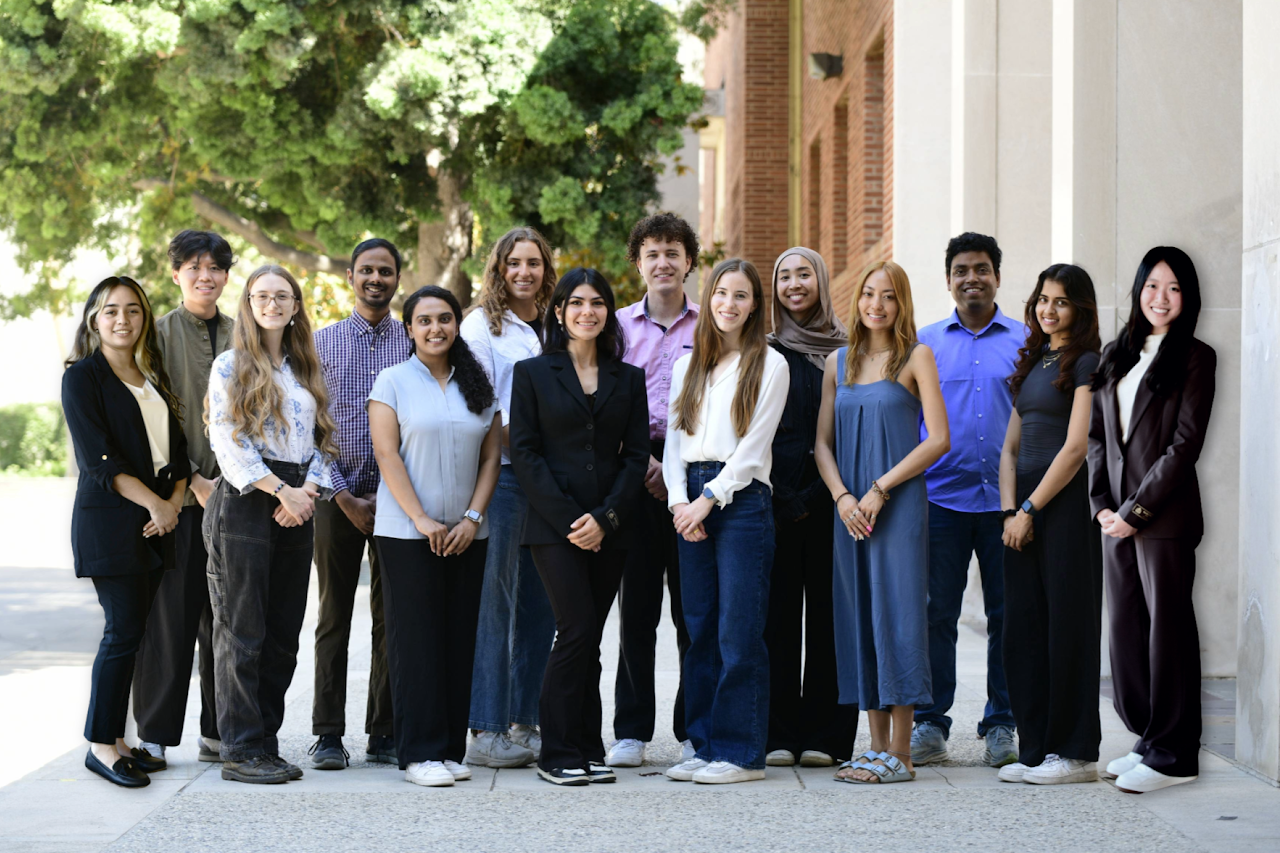
People
Led by Sanjay Mohanty, an associate professor in UCLA Civil and Environmental Engineering, SEALab brings students together to conduct research in the field and lab and share their findings with scientific and public audiences.
Publications
Teaching & outreach
Students use field visits, demonstrations, and design projects to connect classroom concepts with local challenges in stormwater management, waste, and water quality.
Courses and syllabi ↗Join the lab
Interested in student research, graduate study, or collaborating with the lab? Email Dr. Mohanty to ask about current opportunities.
How to join ↗Lab highlights
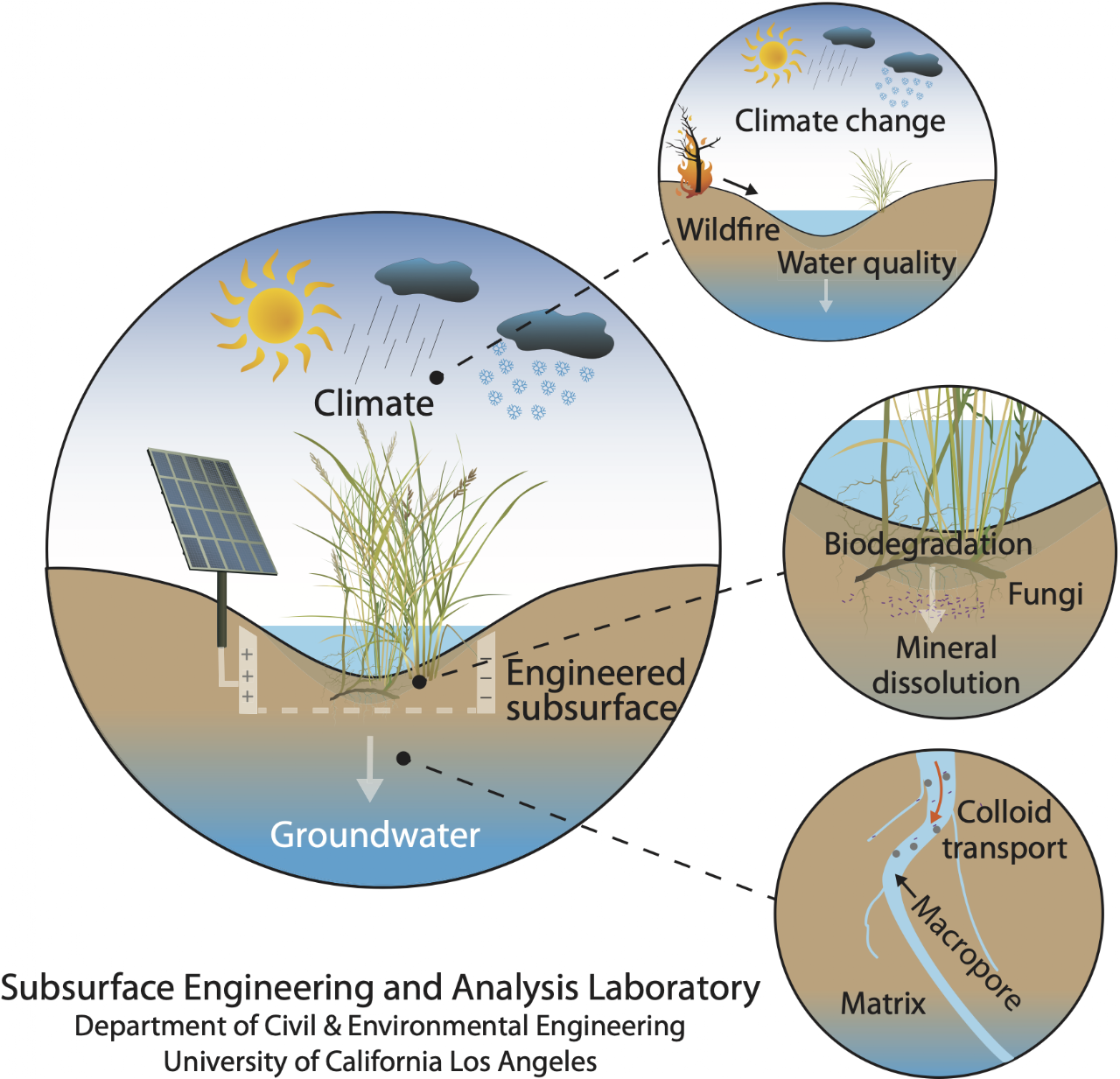
We investigate processes that occur in subsurface soil - the layer responsible to grow food, support terrestrial lives, and keeps our groundwater clean.
Subsurface soil helps filter and degrade pollutants from stormwater and protects groundwater. However, the soil health can deteriorate by anthropogenic activities and under extreme events during climate change. Our team studies the effect of these stressors such as compaction, excess pollutant loading, wildfire, drying, freezing, and flooding on the biogeochemical processes in subsurface soil, and develops innovative engineering solutions to remediate contaminated soils or treat polluted runoff for the protection of drinking water resources in changing climate. We work with federal, state, and local agencies to further these research agendas, and our research informs their policy related to managing soil and water resources. Our work is broadly in these four areas: (1) subsurface processes, (2) remediation, (3) transport of particles or colloids such as microplastics, (4) geochemical and climate forcing of soil microbe.
UCLA SEALs (August 2025, left to right): Carmen Fregoso, Tsz Yu Lau, Vasilisa Kellogg, Chandra Tummala, Aisiri Padaki, Lillian Ott, Alexis Flores, Nouh Sepulveda, Irena Pavlovic, Karina Rahadian, Lisa Lowe, Sanjay Mohanty, Myra Frooq, Claire Young
UCLA SEALs are from more than 10 different countries spanning over 5 continents as shown in the map above. Blue pins represent current members and pink pins represent former members.
Congratulations, Onja, for passing the Ph.D. comprehensive exam (proposal). Her research on wildfire impact on stormwater quality and potential mitigation measures will help millions solving this long term crisis.
In an NETL-supported collaboration with Wayne State University (WSU), researchers used a newly developed sorbent and a process previously developed for nuclear applications to produce an economically viable concentration of rare earth elements (REEs) from domestic coal fly ash, signaling an important step toward commercialization. The new sorbent media developed by WSU researchers, in collaboration with the University of California-Los Angeles (UCLA) and Los Alamos National Laboratory (LANL), successfully concentrated the REEs in a coal fly ash sample taken from a coal-fired power plant near Detroit, resulting in a rare earth oxide (REO) powder of more than 13 percent weight, which demonstrates potential for economic viability.
Congratulations, Cami for publication of her MS thesis work at Environmental Pollution. Her research shows how to best size up biochar, a soil amendment, for the application in roadside biofilters so that they don't break under compaction of soil and don't clog the biofilters that treat road runoff and keep our environment clean. Way to go, Cami, for publishing one lead author and one coauthor paper during your MS, which is a great achievement.
Congratulations, Cami for publication of her MS thesis work at Environmental Pollution. Her research shows how to best size up biochar, a soil amendment, for the application in roadside biofilters so that they don't break under compaction of soil and don't clog the biofilters that treat road runoff and keep our environment clean. Way to go, Cami, for publishing one lead author and one coauthor paper during your MS, which is a great achievement.
Congratulations, Allison, for leading the team of UCLA undergraduate students to win 1st prize in the national competition sponsored by the U.S. Environmental Protection Agency. The team proposed to redesign elements of a Los Angeles elementary school to improve its environmental sustainability. Their project was focused on Brockton Avenue Elementary School, 3 miles southwest of the UCLA campus. The project, Little Steps to a Sustainable Future, received top honors in the Campus RainWorks Challenge’s demonstration project category. In all, 50 teams of college students from 20 states submitted proposals last fall in the competition’s two categories. The winners of the eighth annual contest were announced April 29, 2020.
Announcement: https://www.epa.gov/newsreleases/epa-announces-winners-its-annual-campus-rainworks-challenge
Congratulations Jamie for being selected to receive the prestigious 2020 National Science Foundation (NSF) Graduate Research Fellowship (GRF). She is one of 40 students in Environmental Engineering selected nationwide out of thousands of applicants! We are proud to have her continue to work in SEALab!
Announcement: https://samueli.ucla.edu/five-ucla-engineering-students-receive-2020-nsf-graduate-fellowships/
Congratulations, Annesh, for winning the inaugural John Ries Scholarship. His proposal on using ‘baked’ aggregated clay to treat stormwater was selected, and he is excited to get to work!
Announcement: https://www.escsi.org/e-newsletter/john-ries-2019-20-scholarship-awarded/